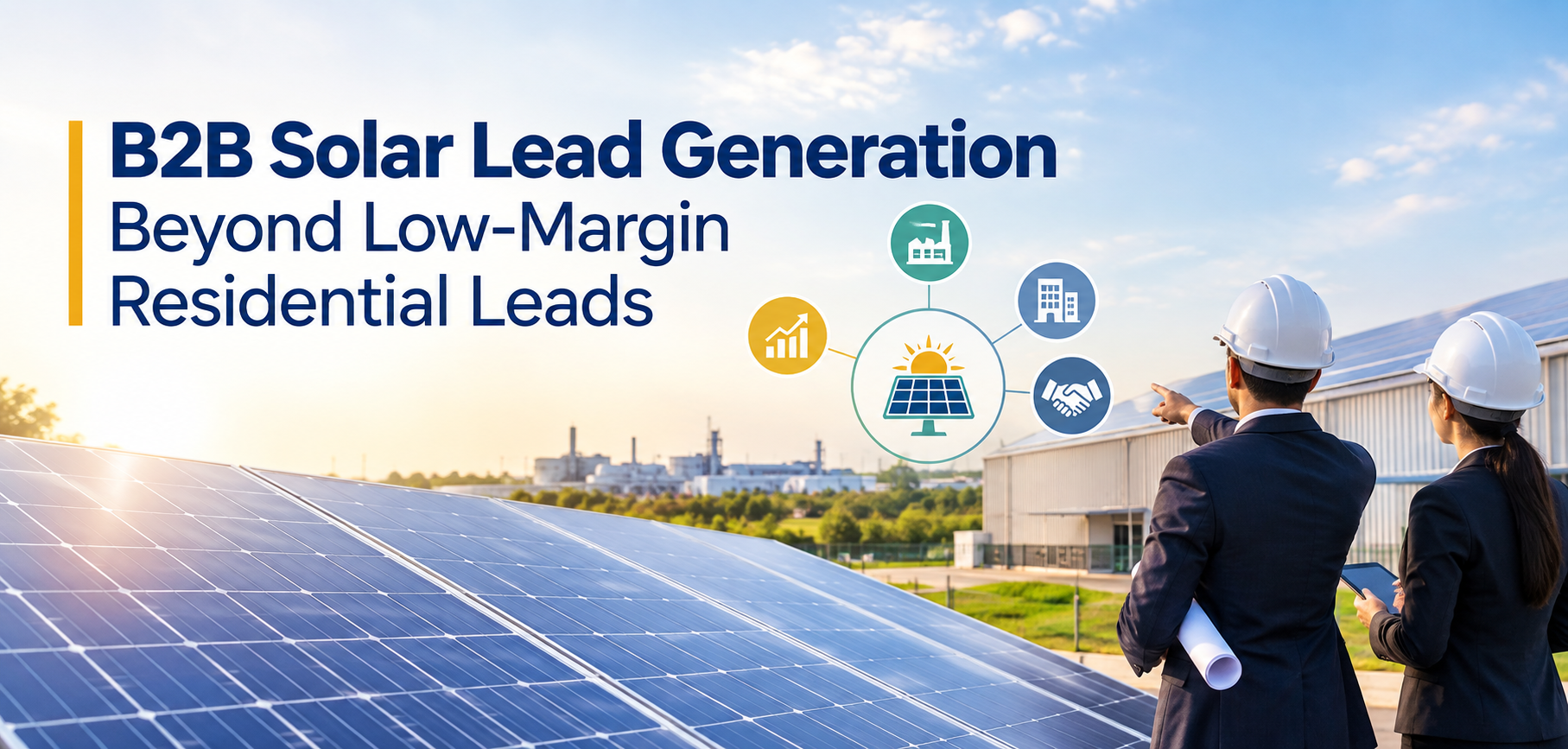
If your solar sales team is spending heavily on leads that produce small residential projects, the problem may not be lead volume. It may be lead quality and customer fit. For B2B solar companies, the bigger opportunity lies in reaching commercial property owners, industrial businesses, EPC decision-makers, and organizations with larger energy requirements.
This guide explains how B2B solar lead generation can move your marketing from high-volume inquiries to more valuable commercial and industrial opportunities. You will also see how SEO, Google Ads, Meta Ads, social media, website development, and performance marketing can work together to support scalable solar customer acquisition.
Why B2B Solar Lead Generation Requires a Different Strategy
Residential solar buyers and commercial buyers rarely follow the same purchasing journey.
A homeowner may compare installation prices and financing options before making a relatively quick decision. A commercial or industrial buyer may need to evaluate:
- Project capacity and energy requirements
- Installation timelines
- ROI and payback expectations
- EPC capabilities
- Financing or procurement requirements
- Technical specifications
- Maintenance and after-sales support
- Multiple internal stakeholders
For example, an industrial manufacturer considering a large rooftop solar installation may not submit an inquiry simply because they saw a social media advertisement. They may first search for commercial solar installers, review technical capabilities, compare companies, and then contact the providers that appear credible.
That makes B2B solar marketing less about generating the maximum number of forms and more about creating a predictable pipeline of qualified opportunities.
Move From Lead Volume to Commercial Solar Leads
A database containing hundreds of low-intent enquiries does not necessarily create a strong sales pipeline.
Your marketing should instead identify the characteristics of your ideal B2B customer. This could include:
Commercial businesses: Offices, warehouses, hotels, hospitals, retail properties, and educational institutions.
Industrial businesses: Manufacturing facilities, factories, processing units, and large warehouses with significant electricity consumption.
Project-driven buyers: Businesses actively planning new construction, facility expansion, or energy-efficiency projects.
When campaigns are built around these segments, your Commercial Solar Lead Generation strategy can become much more focused.
Build Landing Pages Around Buyer Intent
One generic solar services page is rarely enough to address every B2B requirement.
Create dedicated landing pages around high-intent searches such as:
- Commercial solar installation
- Industrial solar solutions
- Rooftop solar for factories
- Solar EPC for commercial projects
- Commercial solar installers
- Industrial solar EPC companies
Each page should answer the questions a serious buyer is likely to ask.
For example, instead of simply saying “We provide solar solutions,” a commercial landing page can explain project assessment, system design, installation capabilities, monitoring, maintenance, and the type of businesses served.
This is where a strong website development strategy becomes important. Your website should support lead qualification, not simply function as an online brochure.
Use Google Ads for High-Intent Solar Searches
Google Ads can be particularly useful when buyers are already searching for a solution.
Suppose a business owner searches for “commercial solar installer” or “industrial solar EPC company.” These searches indicate considerably stronger intent than a person casually engaging with a solar-related social media post.
A focused campaign can separate keywords by commercial intent and send users to relevant landing pages.
Your PPC structure can include:
- Commercial solar campaigns
- Industrial solar campaigns
- Solar EPC campaigns
- Location-specific campaigns
- Brand campaigns
- Remarketing campaigns
The objective should not simply be reducing cost per lead. You should also monitor lead quality, sales-qualified leads, opportunities, and eventual revenue.
A specialist ads agency in Delhi can help structure campaigns around these business outcomes rather than relying only on surface-level advertising metrics.
Don’t Ignore Meta Ads and Social Media
Google captures existing demand. Meta Ads and other social platforms can help create and nurture demand.
For B2B solar companies, social media content can showcase:
- Completed commercial projects
- Installation processes
- Project photographs
- Customer case studies
- Solar ROI considerations
- Energy-cost reduction strategies
- Technical expertise
- Industry-specific solutions
For example, a short case study about how a manufacturing facility approached its solar project can attract decision-makers who may not yet be searching for an installer.
This makes social media useful not only for awareness but also for building trust before the sales conversation begins.
SEO Can Create a Long-Term Source of Industrial Solar Leads
Paid advertising can produce immediate visibility, but SEO can build a sustainable source of organic enquiries.
Your SEO strategy should target different stages of the B2B buying journey.
Commercial Search Terms
These capture users actively looking for providers:
- Commercial solar company
- Commercial solar installers
- Commercial solar solutions
- Commercial solar EPC
Industrial Search Terms
These can reach larger project opportunities:
- Industrial solar company
- Industrial solar EPC
- Industrial rooftop solar
- Solar solutions for manufacturing
Research-Based Searches
These attract prospects earlier in the buying process:
- Commercial solar ROI
- Industrial solar installation cost
- How commercial rooftop solar works
- Solar payback period for businesses
This combination can support Industrial Solar Leads at multiple stages of the decision-making process.
Connect SEO, PPC, and Performance Marketing
The strongest Solar Company Lead Generation strategy does not treat every marketing channel separately.
Consider a potential buyer who searches for commercial solar solutions.
They may:
- Find your website through Google.
- Read a commercial solar guide.
- Leave without submitting a form.
- Later see a Meta Ads campaign.
- Return through a remarketing campaign.
- Download a project checklist.
- Speak with your sales team.
That journey requires coordinated performance marketing in Delhi rather than isolated campaigns.
The important measurement points should include:
- Cost per qualified lead
- Marketing-qualified leads
- Sales-qualified leads
- Lead-to-opportunity rate
- Opportunity value
- Cost per acquisition
- Revenue generated from campaigns
Your Website Should Qualify Leads Before Sales Does
Your website can also reduce wasted sales time.
Instead of asking only for name and phone number, a B2B solar enquiry form could ask:
- Company name
- Industry
- Project location
- Approximate facility size
- Current electricity consumption
- Required project type
- Expected project timeline
This gives your sales team useful context before the first conversation.
A professional website development company in Delhi can structure landing pages, forms, tracking, and conversion paths around this qualification process.
Use a Full-Funnel Approach to Solar Lead Generation
A scalable approach can be divided into three stages.
1. Capture Demand
Use SEO and Google Ads to reach prospects actively searching for solar solutions.
2. Build Consideration
Use case studies, technical content, social media, and remarketing to demonstrate credibility.
3. Convert and Retain
Use high-intent landing pages, qualified enquiry forms, CRM tracking, and sales follow-up to turn opportunities into projects.
This approach makes Solar Lead Generation Services more accountable because marketing performance can be evaluated against actual business outcomes.
Also read: Proven Digital Marketing Strategies for Utility-Scale Solar
Why B2B Solar Companies Should Rethink Residential Lead Dependence
Residential leads can still have value, but they should not automatically become the center of your acquisition strategy if your business is equipped to handle larger projects.
A commercial solar project may involve fewer enquiries but require considerably more technical and sales coordination. Your marketing therefore needs to reflect the value of the customer you actually want to acquire.
For example, an EPC contractor targeting factories should not build its entire acquisition strategy around generic searches for “solar panels near me.” Its content and campaigns should communicate industrial expertise and attract businesses with suitable project requirements.
That is the fundamental shift from solar lead generation to strategic B2B acquisition.
Build a B2B Solar Growth Engine
For solar companies targeting commercial and industrial markets, the goal should be a connected digital acquisition system.
That system can combine:
- SEO for long-term organic visibility
- Google Ads for high-intent demand
- Meta Ads for awareness and remarketing
- Social media for credibility and engagement
- Website development for conversion and qualification
- Performance marketing for measurable growth
- CRM and analytics for tracking the journey from enquiry to revenue
A strong digital marketing company in Delhi can help bring these channels together, while a digital marketing agency in Delhi can structure campaigns around different markets, industries, and buyer segments.
For companies targeting multiple regions, the same framework can also be expanded through a digital marketing agency in India with location-specific SEO and paid campaigns.
The Practical Takeaway
If your sales team needs better commercial opportunities rather than another spreadsheet of low-intent residential enquiries, start by changing what you optimise for.
Define your ideal B2B buyer, build pages around commercial and industrial search intent, use paid campaigns to capture active demand, and track qualified opportunities instead of stopping at lead volume.
That is how B2B solar lead generation becomes a revenue-focused acquisition strategy rather than simply another source of enquiries.
Grow your solar business with performance-focused digital marketing—Visit amsdigital.in | Email: sales@amsdigital.in | Call: +91 9667540071